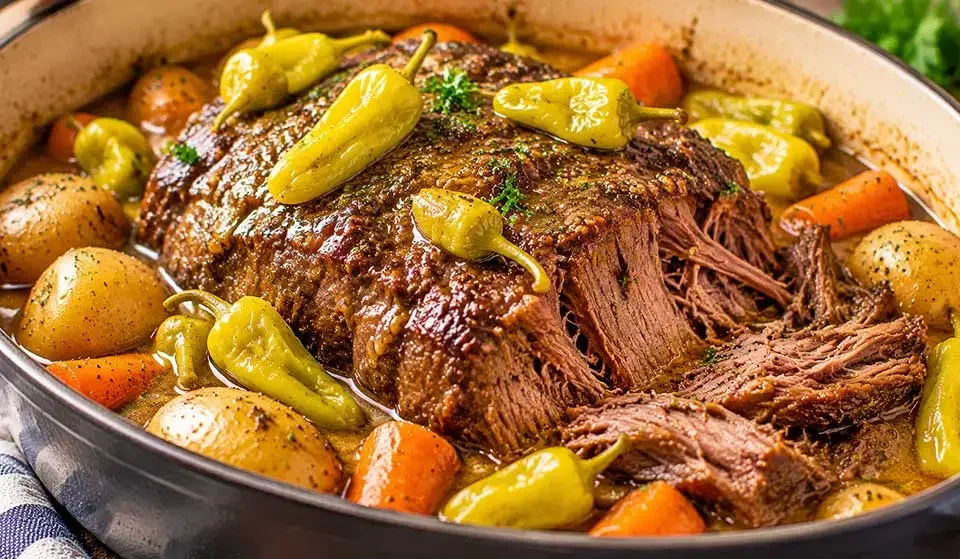

Does your pot roast come out tough, salty or watery? You are not alone. Many home cooks struggle with the same three problems. The meat turns chewy. The sauce tastes too sour. Worse, the gravy ends up thin and greasy. This pepperoncini pot roast fixes all three. Here, you will learn exactly why a Mississippi pot roast fails and how to avoid it. You will pick the right chuck roast, control the brine and set your slow cooker up correctly. Follow the clear, simple steps below. You will also get a quick troubleshooting guide. Soon, you will serve a fork tender roast that melts in your mouth every single time.
Why This Recipe Goes Wrong
A chuck roast holds plenty of collagen and connective tissue. Think of collagen as a tight knot in a rope. Steady heat over many hours slowly loosens that knot into soft gelatin. This change happens slowly between about 160°F and 205°F. So if you rush the cook, the meat stays chewy.
Salt and acid cause the second set of problems. First, the ranch seasoning mix and the au jus gravy mix both carry plenty of salt. Then, in a pepperoncini pot roast the jar brine adds even more salt and a sharp tang. Because the lid traps steam, the liquid never cooks down. As a result, the flavors stay as strong as you made them.
Recipe Card
Time and Servings
| Detail | Time or Amount |
|---|---|
| Prep time | 10 minutes |
| Cook time | 8 to 10 hours on low or 4 to 5 hours on high |
| Rest, thicken and shred time | 30 minutes |
| Total time | 8 hours 40 minutes to 10 hours 40 minutes on low, or 4 hours 40 minutes to 5 hours 40 minutes on high |
| Servings | 6 to 8 |
Ingredients and Exact Quantities
| Ingredient | Exact Quantity (US and Metric) | Why It Matters |
|---|---|---|
| Boneless chuck roast | 3 to 4 lb (1.4 to 1.8 kg) | Marbling and collagen turn soft and juicy |
| Ranch seasoning mix | 1 packet, 1 oz (28 g) | Adds a herby, tangy base |
| Low-sodium au jus gravy mix | 1 packet, 1 oz (28 g) | Builds a savory sauce with less salt |
| Unsalted butter | 4 tbsp (57 g) | Adds richness and softens the acid |
| Whole pepperoncini peppers | 5 to 6 whole peppers (about 2 oz or 50 g) | Add mild heat and tang |
| Brine from the pepper jar | 1/4 cup (60 ml) | Gives tang but turns sharp in larger amounts |
| Low-sodium beef broth | 1/2 cup (120 ml) | Keeps the meat moist and dilutes salt |
| Neutral oil (optional) | 1 tbsp (15 ml) | Helps the roast brown |
| Cornstarch and cold water (optional) | 1 tbsp (8 g) and 2 tbsp (30 ml) | Thickens a thin sauce |
Step-by-Step Method
Step 1: Thaw and Dry the Roast

Step 1. First, thaw the roast fully in the fridge. Pat it dry with paper towels. Then let it rest on the counter for 30 minutes. Dry meat browns much better.
Step 2: Sear the Roast
Step 2. Heat the oil in a skillet over medium-high heat (about 400°F or 200°C). Next, sear the roast for 3 to 4 minutes per side until deep brown. However, you can skip this step if you are short on time.
Step 3: Load the Slow Cooker

Step 3. Place the roast in a 6 quart slow cooker. Sprinkle the ranch mix and the au jus mix over the top. Set the butter on the meat and tuck the peppers around the roast. Finally, pour the brine and the broth around the edges so the seasoning stays on top. For firmer peppers, hold half back and add them during the last 2 hours.
Step 4: Cook Low and Slow
Step 4. Cover the cooker. Then cook on LOW for 8 to 10 hours or on HIGH for 4 to 5 hours. Keep the lid closed the whole time.
Step 5: Check for Doneness
Step 5. Check doneness near the end. A fork should twist in with no resistance. The inside should also read 195 to 205°F (90 to 96°C). If the roast still feels firm, cook it 1 more hour and test again.
Step 6: Rest the Roast and Skim the Fat

Step 6. Move the roast to a plate and tent it loosely with foil. Rest it for 15 minutes. Meanwhile, skim the fat from the juices with a large spoon.
Step 7: Thicken the Sauce
Step 7. Next, whisk the cornstarch with the cold water for a thicker sauce. Stir it into the juices and turn the cooker to HIGH. Cook with the lid off for 15 minutes until the sauce looks glossy. Skip this step if the sauce already looks thick.
Step 8: Shred and Serve
Step 8. Finally, shred the meat with two forks. Return it to the juices and let it sit for 15 minutes. Serve it over mashed potatoes or egg noodles.
Troubleshooting Guide
Even easy recipes go sideways now and then. Use the table below to spot your problem fast. While you troubleshoot, you can also browse more easy slow cooker recipes for backup dinner ideas.
| Problem | Likely Cause | Quick Fix |
|---|---|---|
| Meat is tough | Cooked too short or lid lifted often | Cook 1 to 2 more hours on low |
| Meat is dry and stringy | Lean cut or too long on high | Use chuck roast and rest it in the juices for 15 minutes |
| Roast tastes too salty | Full-sodium mixes plus full brine | Use low-sodium mixes and add 1/2 cup (120 ml) unsalted broth |
| Sauce tastes too sour | Too much brine | Limit brine to 1/4 cup (60 ml) and stir in 1 tsp brown sugar |
| Sauce is watery | Trapped steam adds liquid | Add a cornstarch slurry and cook 15 minutes with the lid off |
| Sauce is greasy | Fatty cut plus butter | Skim the fat with a spoon or chill it and lift it off |
| Peppers turn mushy | Cooked for the full time | Add half the peppers for the last 2 hours |
Now, let’s look closely at the three biggest problems.
Why Is My Pepperoncini Pot Roast Tough?
Tough meat is the number one complaint. Usually the roast simply needs more time. A 3 to 4 lb chuck roast often takes the full 8 to 10 hours on low. So check it with a fork. If the fork resists, close the lid and wait another hour. Lean cuts such as round roast need extra care too. They have less fat and collagen so they dry out faster. Stick with chuck roast for the best fork tender result.
Why Is the Roast Too Salty or Too Sour?

Three things add salt: the ranch mix, the au jus mix and the brine. Low-sodium versions of the mixes cut a lot of that. Next, measure the brine. A quarter cup gives plenty of tang. However, more than that makes the sauce sharp. If the sauce still tastes harsh, stir in 1 teaspoon of brown sugar. You can also serve the shredded beef over plain rice to soften the flavor.
Why Is the Sauce Watery or Greasy?
Slow cookers trap steam. As a result, extra liquid collects instead of cooking off. Fat from the roast and the butter also floats to the top. First, lift the meat out. Next, skim the fat with a large spoon. Then stir in a cornstarch slurry made from 1 tablespoon cornstarch and 2 tablespoons cold water. Finally, cook on high for 15 minutes with the lid off. The sauce will turn glossy and thick.
Cook’s Note
Many cooks find that every lid lift adds 15 to 30 minutes to the cook time. A slow cooker loses a lot of heat each time steam escapes. For example, three quick peeks can stretch an 8 hour roast by 45 to 90 minutes. A common mistake is testing the meat too early. Wait until hour 7 on low before the first fork test.
Mistakes to Avoid
Avoid these four errors and your slow cooker will do the heavy lifting. For side dish ideas, see more comfort food recipes on the site.
Cooking the roast from frozen. Slow cookers heat gently. So a frozen roast stays in the unsafe temperature zone for too long. Thaw a 3 to 4 lb roast in the fridge for 24 to 36 hours. As USDA guidance on safe slow cooking also advises, always thaw meat first.
Stacking full-sodium ingredients. Full-sodium mixes plus pepperoncini brine can taste far too salty. Instead, pick low sodium packets. Also, measure the brine instead of pouring in the whole jar.
Overfilling the slow cooker. A cooker works best when it is half to two-thirds full. A 6 quart model suits a 3 to 4 lb roast well. Too much food slows the heating. On the other hand, a nearly empty cooker can dry the meat out.
Shredding too soon. Hot meat loses juice fast when you tear it apart. So rest the roast for 15 minutes first. After shredding, return the meat to the juices for another 15 minutes. This step soaks in flavor and keeps every bite moist.
Storage and Reheating
Good storage protects both flavor and safety. Refrigerate leftovers within 2 hours of cooking.
| Method | How to Do It | Time Limit | Quick Tip |
|---|---|---|---|
| Fridge | Pack the meat and juices in an airtight container | 3 to 4 days | Cool the roast slightly before packing |
| Freezer | Portion the meat and juices into freezer bags and press flat | Up to 3 months for best quality | Thaw overnight in the fridge |
| Stovetop reheat | Warm in a covered pot on medium-low with a splash of broth | Until steaming hot at 165°F (74°C) | Skip the slow cooker because it heats too slowly |
| Microwave reheat | Cover and heat in 1 minute bursts | Until steaming hot at 165°F (74°C) | Stir between bursts for even heat |
Finally, always check that reheated leftovers reach 165°F before you eat them.
FAQs
Why is my roast still tough after 8 hours?
It likely needs more time. Cook it 1 to 2 hours longer until a fork twists in easily.
Can I fix a roast that tastes too salty?
Yes. Stir in 1/2 cup of unsalted broth and serve the meat over plain mashed potatoes or rice.
Does skipping the sear ruin the roast?
No. Searing adds browned flavor but the meat still turns tender without it.
Why is my sauce watery and how do I thicken it?
Trapped steam adds extra liquid. Stir in a cornstarch slurry and cook on high for 15 minutes with the lid off.
How do I stop the sauce from tasting too sour?
Use only 1/4 cup of brine. Add 1 teaspoon of brown sugar if it still tastes sharp.
Final Thoughts
A pepperoncini pot roast should never feel like a gamble. Pick a chuck roast and measure the brine. Then give the meat enough time. These three habits solve most of the problems.
Here is your next step. Thaw a 3 to 4 lb chuck roast in the fridge tonight. Cook it tomorrow with the steps above. Then serve it over mashed potatoes and save the leftovers for sandwiches.