

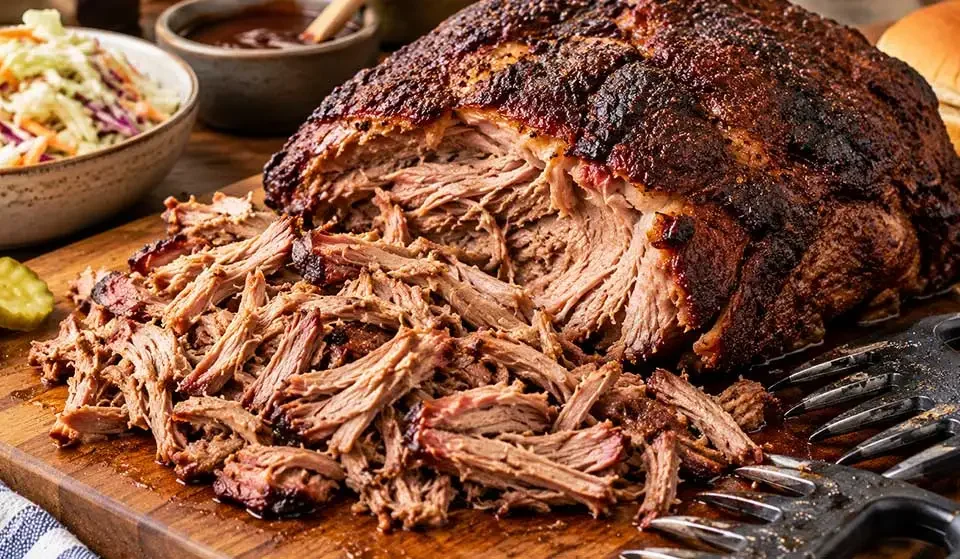

Dinner plans fall apart fast when a big cut of meat turns out dry and tough. Many busy cooks feel that stress, and it is easy to see why. Learning how to cook a pork butt can feel risky when the roast takes hours and you can’t afford a mistake. Don’t worry, because this simple oven method fixes that. Here, you’ll get a make-ahead plan, a clear internal temperature target, and tips that save time. You will see how to pick a Boston butt, season it, and shred juicy pulled pork that feeds a crowd. Next, you’ll find an easy recipe card, smart storage advice, and common mistakes to avoid.
Choosing the Right Ingredients
| Ingredient | What to Look For | Why It Matters |
|---|---|---|
| Pork butt (Boston butt) | Bone-in, 5 pounds, pink with white marbling and a 1/4-inch fat cap | Marbling and bone keep the meat juicy |
| Kosher salt | Coarse, clean flakes | Seasons deeply and builds a crust |
| Brown sugar | Soft and fresh, not hard | Helps the outer bark brown |
| Smoked paprika | Bright red with a smoky smell | Adds color and smoky taste without a smoker |
| Garlic powder | Pure garlic, not garlic salt | Adds flavor without extra salt |
| Black pepper | Freshly ground | Gives gentle heat |
Knowing how to cook a pork butt starts at the store. Choose a bone-in pork butt with plenty of marbling and a thin fat cap. The fat melts as it roasts and bastes the meat. Boneless cuts work too, but they cook faster, so check the temperature an hour early.
Recipe Card
This oven method shows how to cook a pork butt in simple stages: season, roast low, rest, and shred. Every step below gives a temperature, a time, and a doneness cue.
| Detail | Time or Amount |
|---|---|
| Prep time | 15 minutes |
| Seasoning rest | 30 minutes |
| Cook time | 5 to 6 hours |
| Resting time | 30 to 45 minutes |
| Total time | 6 hours 15 minutes to 7 hours 30 minutes |
| Servings | 8 to 10 |
| Oven temperature | 300°F (150°C) |
| Ingredient | US Measure | Metric |
|---|---|---|
| Bone-in pork butt | 5 pounds | 2.3 kg |
| Kosher salt | 2 tablespoons | 30 g |
| Brown sugar, packed | 2 tablespoons | 25 g |
| Smoked paprika | 1 tablespoon | 7 g |
| Garlic powder | 1 tablespoon | 9 g |
| Black pepper | 2 teaspoons | 4 g |
| Water or low-sodium broth | 1/2 cup | 120 ml |
| Barbecue sauce (optional) | 1 cup | 240 ml |
| Hamburger buns | 10 buns | 10 buns |
Step 1. Prep the Pork

First, pat the pork butt dry with paper towels. Trim the fat cap to about 1/4 inch (6 mm), because thick fat blocks the rub. Dry meat browns better and holds seasoning well.
Step 2. Season the Roast
Next, mix the salt, brown sugar, paprika, garlic powder, and pepper in a small bowl. Rub the mix over every side, including the crevices. Let the pork sit at room temperature for 30 minutes while the oven heats. For deeper flavor, season it up to 24 hours ahead and chill it uncovered.
Step 3. Heat the Oven
Heat the oven to 300°F (150°C) and position an oven rack in the lower middle. Set the pork fat side up on a wire rack inside a roasting pan. Pour the water or broth into the pan so the drippings don’t scorch.
Step 4. Roast Low and Slow

Slide a probe thermometer into the thickest part, away from the bone. Roast uncovered for about 3 hours, until the internal temperature reaches 160°F to 170°F (71°C to 77°C). Expect the reading to stall here for a while, and that is normal.
Step 5. Roast Until Tender
Keep roasting for 2 to 3 more hours. For a faster finish, wrap the pork tightly in foil at about 160°F. The USDA safe temperature chart lists 145°F as the minimum for pork roasts, yet this cut needs far more to turn tender. It is ready at 195°F to 205°F (90°C to 96°C), when the probe slides in with no push and the blade bone wiggles free.
Step 6. Crisp the Bark (Optional)
If you want a darker bark, unwrap the pork and raise the oven to 450°F (230°C). Roast it for 15 minutes, until the top turns deep brown. Skip this step if you prefer a softer crust.
Step 7. Rest and Shred

Move the pork to a cutting board and tent it loosely with foil. Rest it for 30 to 45 minutes. Then pull out the bone and shred the meat with two forks, tossing it with the pan juices. Serve on toasted buns with barbecue sauce, and refrigerate leftovers within 2 hours.
Cook’s Note
A common mistake is trusting a single reading near the bone. Bone and fat heat at different speeds, so readings in a 5-pound butt can differ by 10°F to 20°F. Many cooks find that checking three spots and waiting until all of them read at least 195°F gives even, tender meat.
How to Make It Ahead
| Task | Do Ahead or Fresh | How Far Ahead |
|---|---|---|
| Mix the dry rub | Do ahead | Up to 1 week, in a sealed jar |
| Season the pork | Do ahead | Up to 24 hours, covered, in the fridge |
| Roast and shred | Do ahead | Up to 3 days before serving |
| Warm the sauce | Fresh | Day of serving |
| Toast the buns | Fresh | Just before serving |
| Reheat the pork | Fresh | Day of serving, until 165°F |
A make-ahead plan turns a long roast into an easy weeknight meal. Cook on a calm weekend, chill the shredded pork in its juices, and reheat on a busy evening. Also, browse more easy dinner ideas on Recipely to plan the rest of your week.
Storing, Freezing and Reheating
| Method | Best Setup | Time | Key Tip |
|---|---|---|---|
| Refrigerator | Airtight container with a few spoonfuls of juices | 3 to 4 days | Chill within 2 hours of cooking |
| Freezer | Flat freezer bags with the air pressed out | Up to 3 months for best quality | Freeze in meal-size portions |
| Oven reheating | Covered dish with 2 tablespoons of broth | 20 to 30 minutes at 300°F | Heat to 165°F |
| Microwave reheating | Covered bowl with a splash of broth | 60 to 90 seconds per round | Stir between rounds and heat to 165°F |
Food safety rules say to refrigerate leftovers within 2 hours and reheat them to 165°F. Spread the meat in a shallow container so it cools fast. Also, keep a few spoonfuls of pan juices with it, since they protect the leftover pork from drying out.
Dryness and sogginess are opposite problems with simple fixes. To avoid dry meat, reheat it covered, on low heat, with a splash of broth. To avoid soggy buns, keep the sauce separate, toast the buns, and add the sauce just before serving.
Common Mistakes
Pulling It Too Early When Learning How to Cook a Pork Butt
Many cooks stop at 145°F because that is the safe minimum for pork. However, the meat stays tough at that point. Wait until the internal temperature hits 195°F to 205°F and the probe slides in with no push.
Panicking During the Stall
Around 150°F to 170°F, the temperature can sit still for an hour or more. During this stall, evaporation cools the surface, so nothing is wrong. Wait it out, or wrap the roast in foil at about 160°F to speed things up.
Skipping the Rest
Shredding right away lets steam and juice escape. Resting the roast for 30 to 45 minutes under loose foil fixes that. The meat then holds its moisture and pulls apart cleanly.
How Much to Make
| Guests | Raw Pork Butt | Cook Time at 300°F | Pan Size |
|---|---|---|---|
| 2 people | 2 to 3 lb (1 to 1.4 kg), boneless | 2.5 to 3.5 hours | Small roasting pan |
| 6 people | 4 lb (1.8 kg), bone-in | 4 to 5 hours | Standard roasting pan |
| 12 people | 8 lb (3.6 kg), bone-in | 7 to 9 hours | Large roasting pan |
A good rule is about 1/2 pound (225 g) of raw pork per guest. A pork butt loses roughly 30 to 40 percent of its weight as it cooks, and leftovers freeze well. For party menus, check side dish ideas at Recipely before you shop.
FAQs
How far ahead can I cook it?
You can roast and shred it up to 3 days before serving. Chill it in its juices and reheat it gently.
How long do leftovers keep in the fridge?
Store them in an airtight container for 3 to 4 days. Refrigerate them within 2 hours of cooking.
Can I freeze cooked pork butt?
Yes, freeze it in portions for up to 3 months. Thaw it overnight in the fridge before reheating.
Is it hard to learn how to cook a pork butt for a crowd?
Not at all, because the oven does most of the work. Just scale the weight and watch the internal temperature.
How do I scale this recipe for 12 people?
Use one 8-pound butt or two 4-pound butts side by side. Keep the oven at 300°F and add time as needed.
Final Thoughts
Now you know how to cook a pork butt with a simple oven method. The long, low roast softens tough collagen, and the rest keeps the meat juicy. Your next step is easy: buy a bone-in butt and a meat thermometer, season it tonight, and roast it tomorrow. A little planning gives you dinner for days.


